


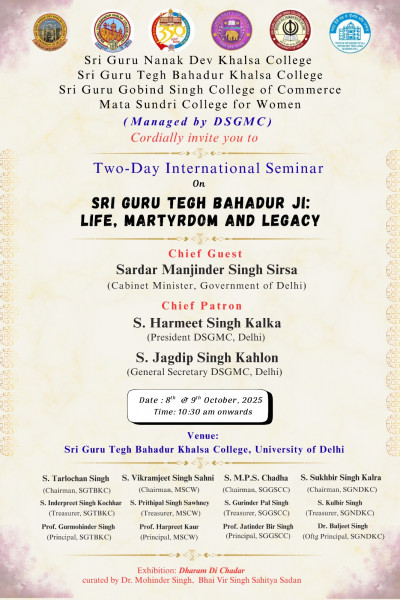
Organized by : Sri Guru Tegh Bahadur Khalsa College, Sri Guru Nanak Dev Khalsa College, Sri Guru Gobind Singh College of Commerce and Mata Sundari College for Women
Location : Inauguration: Master Tara Singh Auditorium Seminar: Guru Arjan Dev Seminar Hall
Time Details : 10:30 am onwards
A Two-Day International Seminar titled "Sri Guru Tegh Bahadur Ji: Life, Martyrdom and Legacy", dedicated to the 350th martyrdom anniversary of Sri Guru Tegh Bahadur Ji, was organized on 8th and 9th October 2025 at Sri Guru Tegh Bahadur Khalsa College, University of Delhi. The seminar was jointly organized by four prestigious Khalsa colleges Sri Guru Tegh Bahadur Khalsa College, Sri Guru Gobind Singh College of Commerce, Sri Guru Nanak Dev Khalsa College, and Mata Sundari College for Women-in collaboration with the Delhi Sikh Gurdwara Management Committee (DSGMC).
The inaugural session was graced by S. Harmeet Singh Kalka, President, DSGMC, and S. Jagdip Singh Kahlon. General Secretary, DSGMC, as the Guests of Honour. The Chief Guest of the inaugural session was S. Manjinder Singh Sirsa, Honourable Cabinet Minister, Government of NCT of Delhi. The programme commenced with a soulful Shabad recitation by Anhad, the Divinity Society of Sri Guru Tegh Bahadur Khalsa College, which created a reflective and spiritual atmosphere for the deliberations. that followed.
The Welcome Address was delivered by S. Tarlochan Singh, Chairman, Governing Body, SGTB Khalsa College. In his address, he reflected upon the historical continuity of Sikh tradition and resistance, situating Guru Tegh Bahadur Ji's martyrdom within a larger narrative of ethical courage, spiritual resilience and unwavering commitment to justice. He emphasized how the Guru's sacrifice continues to inspire collective conscience across generations.
The Keynote Address was delivered by Prof. Harmohinder Singh Bedi (Chancellor, Central University of Himachal Pradesh). Drawing upon Professor Allen's observations, he highlighted Guru Tegh Bahadur Ji's profound role in generating a wave of spiritual awakening across Asia. He further emphasized the Guru's immense contributions to Indian languages and literary traditions through Gurbani.
In his address, S. Jagdip Singh Kahlon urged academic institutions to actively promote research and scholarly engagement with Sikh philosophy among the youth. S. Harmeet Singh Kalka underscored the importance of disseminating Guru Sahib's Bani widely so that its timeless teachings continue to inspire future generations. The Chief Guest, S. Manjinder Singh Sirsa, announced a Government of Delhi initiative to publish an aesthetically designed coffee-table book highlighting the Indian languages employed in Gurbani.
The academic sessions over the two days provided a rich and layered engagement with the life, martyrdom and legacy of Guru Tegh Bahadur Sahib Ji. The second day of the seminar included three academic sessions, followed by the valedictory session. The fourth academic session, chaired by Prof. Harpreet Kaur and Prof. Harbans Singh, focused on religious freedom, martyrdom and Sikh ethical thought.
Prof. Gian Singh Sandhu from Canada considered religious freedom to be a fundamental human right and an essential condition for peaceful coexistence in plural societies. S. Sukhi Bath from Canada discussed martyrdom, or shahidi, as a central and revered concept in Sikhism, defining it as sacrificial death for a just and righteous cause. He also traced how Guru Gobind Singh Ji later established the Khalsa, thereby crystallizing Sikh identity and strengthening the Sikh Panth.
Dr. Devinder Pal Singh from Canada examined the ideals of liberty, equality and fraternity as core principles embedded in Guru Tegh Bahadur Ji's teachings. He highlighted the Guru's vision of a society rooted in moral courage and spiritual equality. Prof. Harbans Singh appreciated the scholarly depth of the presentations and noted that they successfully captured the essence of Guru Tegh Bahadur Sahib Ji's leadership and ethical vision.
The fifth academic session, chaired by Prof. Gurmohinder Singh and Prof. Kulvir Gojra, addressed historical and cultural perspectives. Bhai Amrik Singh from DSGMC, Delhi, highlighted Guru Tegh Bahadur Sahib Ji's three arrests and his conscious choice of martyrdom. Dr. Satinder Singh from SGPC, Amritsar, discussed Bahadurgarh Fort within the broader history of Sikh resistance and emphasized interfaith dialogue and tolerance as reflected in Sri Guru Granth Sahib.
Dr. Roopam Jasmeet Kaur of SGTB Khalsa College highlighted the role of women, particularly Bebe Nanki and the Queen of Bilaspur, in the founding of Chakk Nanaki, noting the importance of matrilineal remembrance. Dr. Ranju Bala from the Punjabi Department presented her paper "Guru Tegh Bahadur Ji: Jeevan Ate Darshan," portraying the Guru as a peace-loving figure and Hind di Chadar.
The sixth academic session, chaired by Prof. Harbans Kaur Saggoo and Dr. Baljeet Singh, focused on philosophical and literary perspectives. Dr. Aditya Kumar Kaushal from Gargi College spoke on the universality of the Gurus' shabads and the transcendence of duality. Dr. Tarvinder Kaur from SGGSC discussed attachment and detachment as inner states of consciousness. Dr. Manjeet Singh from SGND Khalsa College analysed the play "Chandni Chowk ton Sirhind Tak," while Dr. Ravinder Kaur Bedi from SGTB Khalsa College reflected on the martyrdom of Bhai Mati Das Ji, Bhai Sati Das Ji and Bhai Dyala Ji.
In her concluding remarks, Prof. Harbans Kaur Saggoo emphasized martyrdom as a means of protecting human rights and highlighted Sikh fearlessness.
The valedictory session was graced by Prof. Manjeet Singh. Former Jathedar of Akal Takht Sahib, as Chief Guest. Prof. Harpreet Kaur emphasized the sanctity of human rights and the importance of duty. Dr. Mohinder Singh highlighted the role of Sikh studies and curated an exhibition on Guru Tegh Bahadur Ji. Prof. Manjeet Singh reflected on the Guru's spiritual resolve and enduring legacy.